
Regulatory Chemistry and Human Health Assessment
Protecting human health is a fundamental objective of global chemical regulations. Regulatory frameworks are designed to minimize both intentional and unintentional exposure to chemical substances, ensuring their safe manufacture, handling, and use. To achieve this, regulatory authorities impose rigorous and complex assessment requirements.
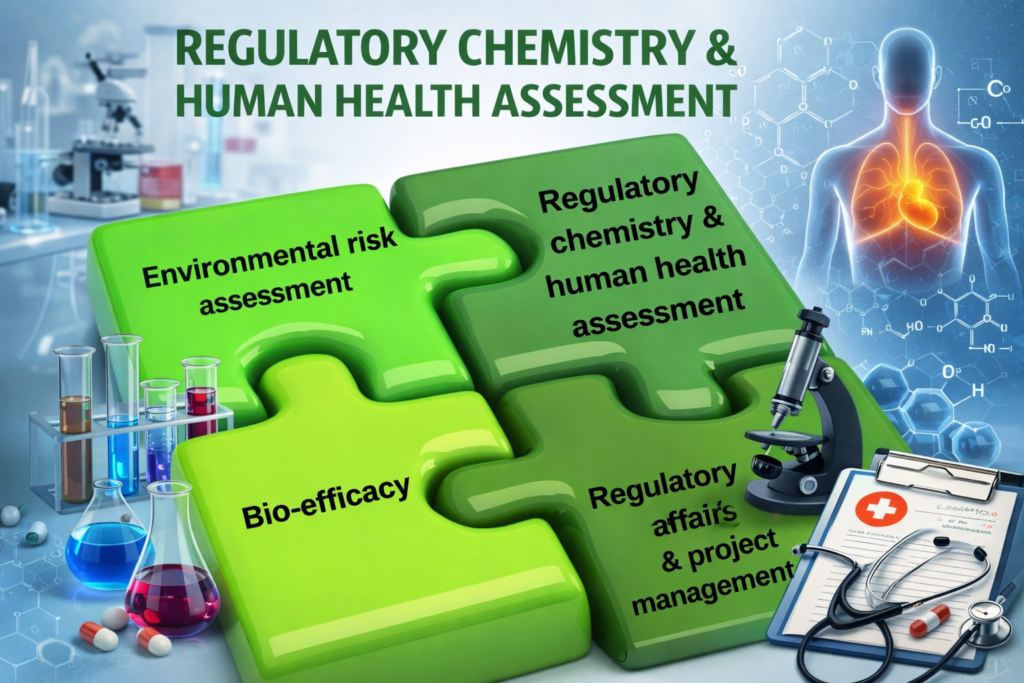
The regulatory chemistry and human health assessment team at Auxilife provides comprehensive scientific and regulatory support to meet these requirements. Our experts design and oversee testing programs to evaluate physico-chemical properties and toxicological effects in full compliance with internationally recognized guidelines.
Our specialists support the classification and labelling of chemical substances and formulated products based on defined hazard endpoints. By integrating hazard characterization with realistic exposure scenarios, we conduct robust risk assessments to protect workers, operators, handlers, consumers, and the general public.
Auxilife delivers human health risk assessment services across a wide range of sectors, including agrochemicals, biocides, fine and specialty chemicals, consumer products, pharmaceuticals (preclinical), cosmetics, medical devices, and food and feed additives.
Our Key Services
- Data gap analysis and regulatory dossier completeness checks
- Comprehensive scientific literature reviews and weight-of-evidence evaluations
- Preparation of expert statements and scientific reports, including exposure-based waivers (TTC and read-across approaches)
- Development and oversight of testing programs for physico-chemical properties of substances and formulations
- Development of technical specifications and chemical equivalence strategies
- Monitoring and evaluation of analytical method studies for residue determination in plants, food, and feed commodities
- Design, placement, and monitoring of toxicological studies to define hazard endpoints
- Exposure assessments for operators, workers, bystanders, and residents related to plant protection products and pesticides
- Dietary exposure assessments for residues of plant protection products in food commodities
- Safety assessments of food and feed additives and food contact materials
- Assessment of potential endocrine-disrupting properties
- Evaluation of relevance and reliability of published scientific literature
- Preparation of complete regulatory dossiers for submission to authorities