
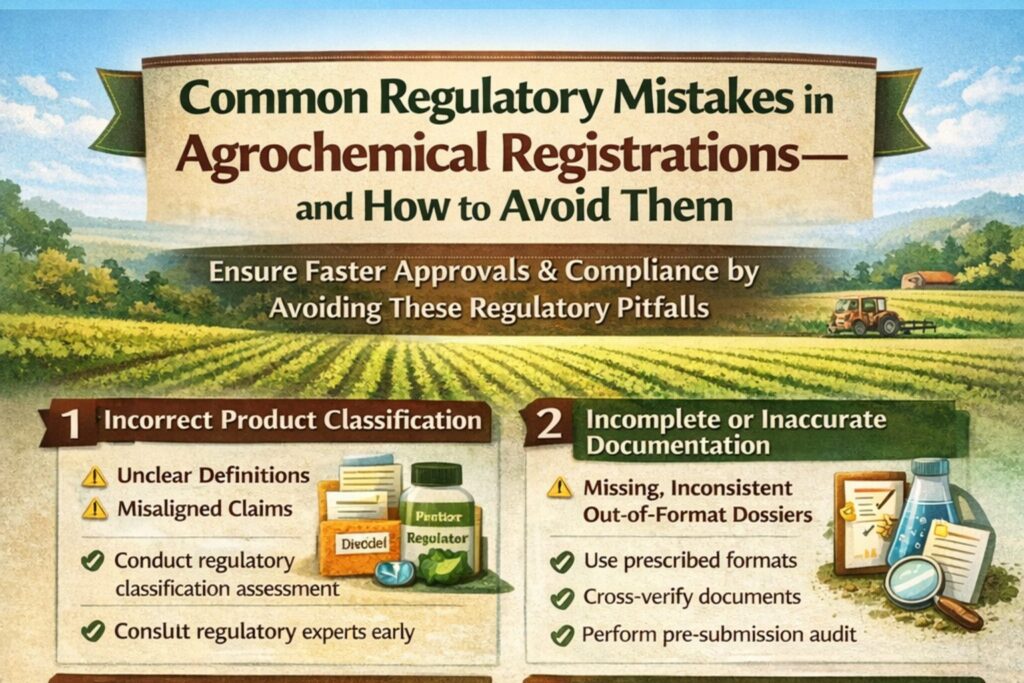
Agrochemical registrations in India are governed by strict regulatory frameworks such as the Insecticides Act, 1968, the Fertiliser (Control) Order, 1985 (FCO), and other allied guidelines. Despite growing awareness, manufacturers and importers often face approval delays, rejections, or compliance actions due to avoidable regulatory mistakes.
Understanding these common pitfalls—and knowing how to prevent them—can save time, cost, and reputational risk.
1. Incorrect Product Classification
The Mistake:
One of the most frequent issues is misclassifying a product—such as registering a biostimulant as a fertilizer, or a plant growth regulator under the wrong category.
Why It Happens:
- Overlapping definitions
- Marketing-driven classification
- Lack of regulatory interpretation
How to Avoid It:
✔ Conduct a detailed regulatory classification assessment
✔ Align product claims strictly with applicable regulations
✔ Seek expert guidance before dossier preparation
2. Incomplete or Inaccurate Documentation
The Mistake:
Submitting dossiers with missing data, inconsistencies, or incorrect formats.
Common Gaps Include:
- Incomplete product specifications
- Missing manufacturing flow charts
- Inadequate quality control parameters
- Errors in labels and declarations
How to Avoid It:
✔ Use authority-prescribed formats and checklists
✔ Cross-verify all technical and administrative documents
✔ Perform a pre-submission compliance audit
3. Weak or Non-Compliant Bio-Efficacy Data
The Mistake:
Submitting bio-efficacy trials that do not meet regulatory protocols or crop/geography requirements.
Impact:
- Objections from authorities
- Requests for repeat trials
- Significant approval delays
How to Avoid It:
✔ Conduct trials at approved institutions
✔ Follow officially notified guidelines
✔ Ensure data reflects Indian agro-climatic conditions
4. Non-Compliant Labeling and Packaging
The Mistake:
Labels containing unapproved claims, missing statutory declarations, or incorrect usage instructions.
Regulatory Risk:
- Application rejection
- Post-approval enforcement actions
- Product recalls or penalties
How to Avoid It:
✔ Ensure labels strictly comply with FCO/Insecticide Rules
✔ Avoid exaggerated or unsupported claims
✔ Get labels vetted before submission and printing
5. Ignoring Regulatory Updates and Amendments
The Mistake:
Relying on outdated guidelines or failing to comply with recent amendments.
Why This Is Risky:
Indian agrochemical regulations evolve frequently, especially for biostimulants and specialty products.
How to Avoid It:
✔ Track regulatory notifications and circulars
✔ Update dossiers and labels as per latest requirements
✔ Maintain an ongoing compliance monitoring system
6. Poor Coordination with Multiple Authorities
The Mistake:
Lack of alignment between central registration, state licensing, and import permissions.
Result:
- Operational delays
- Inability to sell or distribute products despite approval
How to Avoid It:
✔ Plan central and state approvals in parallel
✔ Maintain consistent documentation across authorities
✔ Assign a single regulatory coordination team
7. Delaying Professional Regulatory Support
The Mistake:
Approaching regulatory consultants only after receiving objections or rejections.
Cost of Delay:
- Higher compliance costs
- Lost market opportunities
- Reputational damage
How to Avoid It:
✔ Engage regulatory experts early in product development
✔ Conduct data gap and feasibility analysis upfront
✔ Build a long-term compliance strategy, not just approvals
Conclusion
Most regulatory challenges in agrochemical registrations are not due to policy barriers—but due to avoidable procedural and documentation errors. With increasing scrutiny from Indian regulatory authorities, proactive compliance and strategic planning are no longer optional.
By identifying common mistakes early and adopting best practices, manufacturers and importers can achieve faster approvals, reduced risk, and sustainable market presence.
Professional regulatory guidance plays a critical role in ensuring that your agrochemical products meet all legal, technical, and commercial requirements—right from day one.